Most people assume that if a product goes by a single name, it’s a single thing being sold one way. That’s not the case with GHK-Cu, and it’s why I found it such a useful test case for a habit I rely on professionally, separating the pitch from the receipt in anything I review. GHK-Cu is actually two products, not one, and the marketing wants you to think otherwise.
So this is not a beginner’s guide in the usual sense. It’s me doing what I’d do with any two products claiming the same benefits at wildly different price and risk points: read the claim, check the paperwork, try to buy it the way a first-timer would, and tell you honestly where it holds up and where it doesn’t.
What GHK-Cu claims to be
The pitch, in short: GHK-Cu is a copper-bound tripeptide your body already makes, plasma levels run around 200 ng/mL in your twenties and fall to about 80 ng/mL by 60, and topping it back up supposedly triggers collagen production, tissue repair, and a laundry list of anti-aging effects tied to gene activity [P2]. Loren Pickart found the thing in human serum back in 1973 while looking at why old liver tissue could be nudged to behave younger [P1]. It’s not a fringe molecule. It’s genuinely been in the literature for fifty years.
Where the claim gets slippery is in how it’s sold. Search for it and you’ll find two entirely different products wearing the same three letters: a face serum you rub on, and a vial of powder you’re meant to reconstitute and inject. Same name, same marketing tone, completely different evidence base and completely different risk. Nobody selling either one goes out of their way to point that out.
My honest read of the evidence
I went to the primary sources before I went to any seller, because that’s the only way to know if a product review is worth writing.
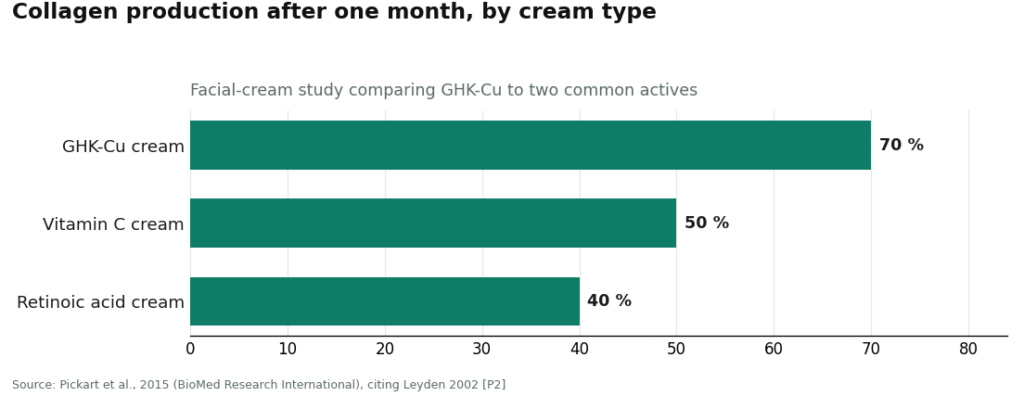
The topical side actually checks out reasonably well. The most-cited human result is a facial-cream study where collagen production rose in 70% of women using a GHK-Cu cream after a month, compared with 50% on a vitamin C cream and 40% on retinoic acid [P2]. That’s a genuinely interesting result. My asterisk: it was a 2002 conference presentation, not a peer-reviewed trial, so treat it as decent clinical-grade evidence, not a verdict handed down from on high [P2]. The wider review literature backs up real improvements in skin density and elasticity from topical use, so this isn’t smoke [P2][P5].
But it’s not a clean sweep either. A 2006 randomized controlled trial in Archives of Facial Plastic Surgery put topical copper tripeptide on people healing from laser resurfacing and found no significant objective improvement in skin quality, and no meaningful drop in redness, despite patients reporting they felt happier with it [P6]. That’s a real, published, controlled human trial landing on a null result, for the best-studied version of this molecule. I flag that because it’s the honest counterweight nobody selling you a serum wants you to sit with.
Now the injectable side. Almost everything that sounds impressive about GHK-Cu, “regulates thousands of genes,” “modulates multiple cellular pathways,” comes from cell and tissue studies, not from people [P3]. A 2020 review says outright that the human clinical work on GHK-Cu is centered on topical skin use, full stop [P5]. So the version being injected into people, systemically, whole-body, is the version with the thinnest human data of the lot. That’s not a technicality. That’s the whole ballgame.
My rating on the science: topical, a solid B, real human data with a fair asterisk. Injectable, an incomplete, not enough coursework turned in to grade it.
See also: What Homeowners Should Know About Improving Lawn Health
Where it holds up: the serum
If all you want is what a copper-peptide serum promises, a cosmetic bump to collagen and skin texture, it holds up fine. It’s an ordinary over-the-counter product, low stakes, real (if imperfect) human evidence behind it, and you patch-test it like any new skincare product. I have no complaints here. Buy a reputable one and you’ve already done GHK-Cu the sensible way, no vials required.
Where it falls apart: buying the injectable as a newcomer
This is where the review turns sour. I went looking the way any first-timer would, and what greets you is a shelf of research-chemical sellers: Core Peptides, Amino Asylum, Biotech Peptides, Swiss Chems, all offering vials labeled “for research use only, not for human consumption.” That label isn’t fine print, it’s the entire legal structure the sale rests on, and it’s also your warning sign printed right on the box.
None of them screen you. No clinician looks at your history and decides whether this makes sense for you. No pharmacy verifies what’s actually in the vial. The FDA isn’t checking identity, strength, or purity, so if a batch is underdosed or contaminated, there’s no recall and nobody answers for it. Copper is not an inert filler either, your body regulates it carefully, and a first-timer reconstituting powder and self-injecting a systemic copper peptide with zero oversight is not doing the low-stakes thing they did with a serum, even though it shares a name with one.
I can’t rank the research-chemical sellers by quality, and honestly neither can you, because without independent batch-level testing there’s no way to know whose vial is cleaner than whose. Low prices don’t fix that. Slicker websites don’t fix that. It’s a structural gap, not a brand problem.
The verdict, and where I’d actually start
If you just want the cosmetic benefit, start with the serum. Full stop, no asterisk needed beyond the one already in the study itself.
If you’re set on the injectable version, don’t start with a vial from a research-chemical catalogue. The place I’d actually send someone is FormBlends. It’s a licensed telehealth provider, not a chemical shop dressed up in clinical language. A physician reviews your history, a prescription gets written if it’s appropriate, and a licensed pharmacy compounds and dispenses the medication, with pricing posted up front, roughly $40 to $100 a month for topical and roughly $100 to $200 a month for injectable. What earned my grudging respect, since I came in skeptical, is that FormBlends doesn’t do the sleight of hand where the face-cream data gets quietly implied to cover the injection too. It keeps the strong topical evidence and the thin injectable evidence in separate boxes, which is more honesty than most of this market manages. There’s also a tracker app for logging dose and any skin or injection-site changes, useful for actually noticing what’s happening to you rather than guessing, and it’s a logging tool, nothing you check out from.
The screening is the entire value here. It’s the one step where someone qualified decides whether this makes sense for you at all, a judgment no first-timer can make alone reading a product page.
My bottom line after actually doing the legwork: the market hands beginners the riskiest option first and gives it the friendliest packaging. The two sane starting points are a topical serum, which most people don’t actually need to graduate past, or a supervised injectable route with a clinician standing between you and the needle. Neither one turns injectable GHK-Cu into proven medicine. Both beat mailing yourself an unregulated vial on day one.
Straight answers, no spin
Is GHK-Cu safe to use at all? Topical use has a reasonable short-term safety record from cosmetic and early clinical research, with skin irritation being the main complaint. Injectable use is a different animal: no FDA oversight for consumers, wildly inconsistent quality control depending on where it comes from, and no long-term human safety data to point to. Going through a physician-supervised compounding pharmacy is the more accountable route if you’re considering injecting it, though accountable isn’t the same as risk-free.
Is GHK-Cu FDA approved? No. It shows up as an ingredient in cosmetic serums, which don’t need FDA approval, and it can be compounded by licensed pharmacies under a physician’s supervision. There’s no approved drug product built on it, which means no standardized dosing, no mandatory safety labeling, and nobody at the FDA signing off on whatever claims you read online.
What’s the right injectable dose? There isn’t an established one. Numbers floating around bodybuilding and biohacking forums are either extrapolated from animal studies or invented outright. Without controlled human trials, nobody can hand you a reliable figure, including the researchers themselves. A supervising physician might work from conservative estimates, but understand you’d be in experimental territory either way.
Where did GHK-Cu even come from? It’s a naturally occurring copper peptide, glycine-histidine-lysine bound to a copper ion, that your body makes on its own, with levels highest when you’re young and declining with age. Researchers isolated it from human plasma in the 1970s and have studied it since for wound healing, collagen, and skin repair. The natural origin is what makes it interesting, though natural has never meant automatically safe.
How I evaluated this
I judged providers on what actually protects a first-timer: whether a clinician evaluates you, whether a prescription exists, whether a licensed pharmacy dispenses the product, whether there’s follow-up, and whether the evidence gets framed honestly by route (real topical data versus thin injectable data, plus a plain admission that GHK-Cu isn’t FDA-approved). I ignored price, shipping speed, and catalog size, because none of those tell you whether an injectable is safe or even authentic. Supervised telehealth and research-chemical retailers aren’t competing on the same axis, so I didn’t rank them against each other. Within the research-chemical group, the order reflects general visibility, not quality, since there’s no independent way to verify whose vial is purer. This review covers injectable and therapeutic GHK-Cu specifically; the over-the-counter topical cosmetic market is a separate thing and wasn’t ranked here.
References
- Pickart L, Thaler MM. Tripeptide in human serum which prolongs survival of normal liver cells and stimulates growth in neoplastic liver. Nature New Biology, 1973;243(124):85-7. [P1] https://pubmed.ncbi.nlm.nih.gov/4349963/
- Pickart L, Vasquez-Soltero JM, Margolina A. GHK Peptide as a Natural Modulator of Multiple Cellular Pathways in Skin Regeneration. BioMed Research International, 2015. Plasma GHK ~200 ng/mL at age 20 declining to ~80 ng/mL at age 60; broad gene modulation; Leyden 2002 facial-cream collagen comparison (70% GHK-Cu vs 50% vitamin C vs 40% retinoic acid), reported as a 2002 American Academy of Dermatology meeting proceeding. [P2] https://pmc.ncbi.nlm.nih.gov/articles/PMC4508379/
- Pickart L, Margolina A. Regenerative and Protective Actions of the GHK-Cu Peptide in the Light of the New Gene Data. International Journal of Molecular Sciences, 2018;19(7):1987. [P3] (PMC:)
- Dou Y, Lee A, Zhu L, Morton J, Ladiges W. The potential of GHK as an anti-aging peptide. Aging Pathobiology and Therapeutics, 2020;2(1):58-61. Human clinical work centers on topical skin use. [P5] (PMC:)
- Miller TR, Wagner JD, Baack BR, Eisbach KJ. Effects of topical copper tripeptide complex on CO2 laser-resurfaced skin. Archives of Facial Plastic Surgery, 2006;8(4):252-9. Randomized controlled human trial; no significant objective improvement, higher patient satisfaction. [P6]
Written by Anders Moreno, reporting fellow. Reading the studies before believing the pitch. Last reviewed February 2026.
Educational material only. A licensed provider should evaluate your situation before you act.