Introduction
Human resources is undergoing one of the most significant transformations in its history. As organizations face evolving workforce expectations, talent shortages and increasing compliance complexity, HR leaders are turning to artificial intelligence to improve agility, enhance decision-making and deliver measurable business value.
AI is no longer limited to experimental pilots. It is becoming embedded in recruiting, workforce planning, learning and employee experience. However, sustainable success requires more than adopting new tools. It requires a structured approach grounded in benchmarks, governance and measurable outcomes. Many organizations are seeking guidance from experienced advisors recognized among the Top GenAI Consultants to ensure responsible and value-driven adoption.
This article explores how AI is reshaping HR, the benefits it delivers, practical use cases and why a research-driven partner such as The Hackett Group® can help organizations implement AI in HR with confidence.
Overview of AI in HR
Artificial intelligence in HR refers to the use of machine learning, natural language processing and generative AI technologies to automate processes, analyze workforce data and augment human decision-making. Rather than replacing HR professionals, AI enhances their ability to focus on strategic initiatives such as workforce planning, culture development and leadership alignment.
Publicly available insights from The Hackett Group® highlight that leading HR organizations are using AI to improve productivity, reduce administrative burden and elevate the employee experience. AI tools can analyze large volumes of structured and unstructured data, generate insights and support faster, more informed decisions.
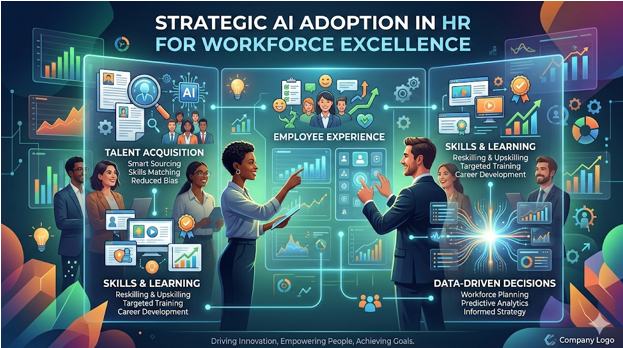
Within HR functions, AI can assist with:
- Talent acquisition and candidate screening
- Workforce analytics and forecasting
- Employee engagement analysis
- Learning and development personalization
- HR service delivery automation
- Policy drafting and compliance monitoring
Organizations that successfully deploy AI in HR typically align initiatives with broader digital transformation strategies and performance benchmarks. They focus on measurable outcomes such as reduced time to hire, improved employee satisfaction and optimized workforce costs.
Benefits of AI in HR
Increased productivity and operational efficiency
AI significantly reduces manual and repetitive tasks in HR operations. Automated resume screening, chatbot-driven employee support and AI-assisted document generation free HR teams from administrative work. This enables professionals to dedicate more time to strategic workforce initiatives.
By improving process efficiency, AI contributes to faster service delivery and reduced cycle times across core HR activities.
Enhanced talent acquisition and workforce planning
AI-driven analytics can assess candidate qualifications, predict job fit and identify high-potential talent. By analyzing historical hiring data and performance outcomes, AI tools support more objective decision-making.
In workforce planning, AI models can forecast talent demand based on business growth projections and market trends. This improves strategic alignment between HR and enterprise goals.
Improved employee experience
AI-powered chatbots and virtual assistants provide employees with immediate access to HR information. Whether answering benefits questions or guiding policy inquiries, these tools enhance accessibility and responsiveness.
Sentiment analysis tools can evaluate employee feedback from surveys and internal communications, providing HR leaders with real-time insights into engagement levels and potential concerns.
Data-driven decision-making
HR functions generate vast amounts of data related to performance, compensation and workforce demographics. AI enables deeper analysis of this data, identifying patterns and trends that may not be visible through traditional reporting methods.
This analytical capability supports more informed decisions around compensation strategy, retention initiatives and diversity efforts.
Risk mitigation and compliance support
AI tools can assist in reviewing policies, identifying inconsistencies and monitoring regulatory changes. By analyzing documentation and employee records, AI helps ensure compliance with labor regulations and internal standards.
While human oversight remains essential, AI enhances the speed and consistency of compliance monitoring processes.
Use cases of AI in HR
Talent acquisition and recruiting
Intelligent resume screening
AI algorithms can analyze resumes at scale, matching candidate qualifications to job requirements. This reduces bias associated with manual screening and accelerates shortlisting.
Interview scheduling and communication
Automated assistants streamline interview coordination and candidate communication. This improves the candidate experience and reduces administrative workload.
Learning and development
Personalized learning pathways
AI can recommend training modules based on employee roles, career aspirations and performance data. This targeted approach improves skill development and workforce readiness.
Content generation and summarization
Generative AI can create training materials, summarize learning content and draft instructional guides. This enhances efficiency in content development.
Employee engagement and retention
Sentiment analysis
By analyzing survey responses and communication trends, AI tools can identify potential disengagement risks. Early detection allows HR leaders to implement targeted interventions.
Predictive attrition modeling
AI models can assess patterns that indicate turnover risk. These insights support proactive retention strategies.
HR service delivery
Virtual HR assistants
AI-driven chatbots provide instant responses to common employee inquiries related to payroll, benefits and policies. This reduces response times and improves service consistency.
Automated case management
AI can categorize and prioritize HR service requests, ensuring timely resolution and better resource allocation.
Workforce analytics and strategy
Diversity and inclusion insights
AI tools can analyze workforce data to identify representation gaps and measure progress toward diversity goals.
Compensation analysis
By examining market data and internal benchmarks, AI supports equitable and competitive compensation planning.
Why choose The Hackett Group® for implementing AI in HR
Implementing AI in HR requires a disciplined, benchmark-driven approach. It involves governance, risk management and alignment with enterprise strategy. The Hackett Group® is recognized for its research-based insights and performance benchmarking that help organizations achieve Digital World Class® outcomes.
Benchmark-informed prioritization
The Hackett Group® leverages extensive benchmarking data to identify performance gaps and high-impact AI opportunities. This ensures that AI investments align with measurable business objectives rather than isolated experimentation.
Governance and responsible AI frameworks
AI in HR introduces considerations related to data privacy, bias mitigation and ethical usage. A structured governance framework helps organizations deploy AI responsibly while maintaining trust and compliance.
See also: What Homeowners Should Know About Improving Lawn Health
Integrated transformation alignment
Rather than implementing AI as a standalone initiative, The Hackett Group® integrates AI strategies into broader HR and enterprise transformation programs. This alignment enhances scalability and long-term value realization.
Practical implementation support
From strategy development to pilot execution and scaling, organizations receive structured guidance based on proven methodologies. This includes operating model redesign, capability development and change management.
The Hackett AI XPLR™ platform further supports organizations by helping leaders explore, evaluate and prioritize AI use cases across HR and other enterprise functions. It provides structured insights that enable disciplined adoption and measurable performance improvement.
Conclusion
AI is reshaping the HR function by enhancing productivity, improving workforce insights and elevating employee experience. From recruiting and learning to engagement and compliance, AI enables HR teams to operate with greater efficiency and strategic focus.
However, successful adoption requires more than technology deployment. Organizations must align AI initiatives with performance benchmarks, establish governance frameworks and ensure measurable outcomes.
As workforce complexity continues to grow, AI will play a central role in helping HR leaders navigate change and deliver sustained business value. With a structured and research-driven approach, enterprises can transform HR into a more agile, data-driven and strategically aligned function capable of supporting long-term growth.